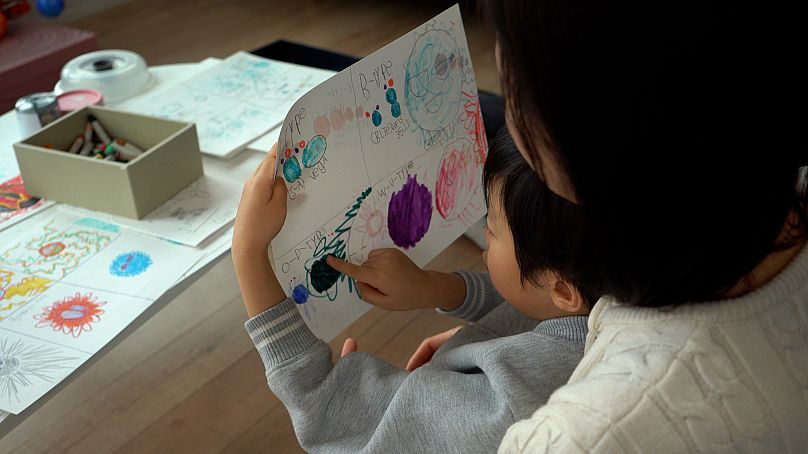
In their living room in South Korea, a dad is employing generative artificial intelligence (genAI) technology to transform his child's artwork into video segments and brief narratives, ushering in a novel form of entertainment during playtime.
Every week, the Kim family visits the library where they select a book. Afterward, they read it collectively, talk about something intriguing, and enhance their understanding of various subjects.
Knowing young children can’t engage with AI tools independently, father Kim Jungu prepares a short, 30-minute AI session by writing tailored prompts in advance.
In one of the sessions, his five-year-old son Dohun interacts creatively with the AI by designing an imaginary planet or crafting a narrative based in the Orion constellation.
The AI tutor enhances engagement by posing additional queries and providing fresh insights connected to the subject matter.
"I truly enjoy what she discovered since each time, the AI presents highly intriguing questions for me and shares valuable mathematical or scientific insights too. Thus, I feel like I gain new knowledge weekly," said Kim, who serves as the Chief Product Officer (CPO) at an IT company, to Euronews Next.
Dohun has a passion for both outer space and sketching. Kim thinks of AI as an invaluable resource that can address queries even parents might find challenging, aiding his child in discovering new avenues for imagination and creative expression.
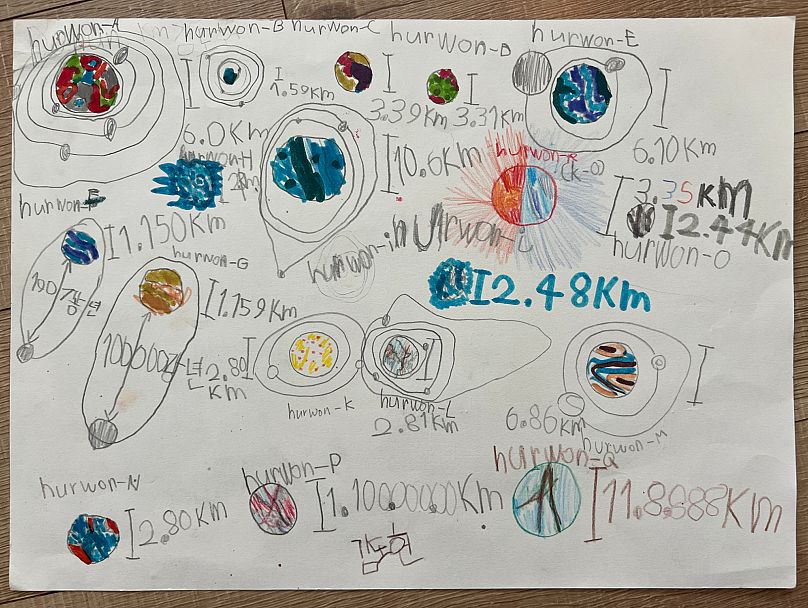
"I can tell that his scope is broadening. While last week we delved into solar systems, today he’s focusing on the outer regions of our solar system. AI keeps providing him with fresh ideas," he noted.
Although he believes that AI has the potential to enhance children's learning, he is conscious of the danger of becoming overly dependent on this technology.
"It’s crucial too that they do not grow excessively reliant on it. As a parent, I consider how to cautiously navigate this process. Handling individual learning metrics is an additional worry," Kim mentioned.
Critical thinking is key
Experts in AI-driven education emphasize that the primary focus should be on the act of playing, with parents ensuring that the duration and intensity of these sessions align well with their child’s developmental stage.
Professor Kwon Jung-min, an expert in AI education from Seoul National University of Education, remarked to Euronews Next, "They might as easily be building with Lego bricks..."
"From my viewpoint, it doesn't truly matter what tools they are using, as long as they are fostering a strong relationship—even if artificial intelligence serves as their intermediary," she went on to say.
"But if it was more frequent or if it was maybe more than two hours per day, that might be too much. It depends on the child's age and their interest".
Kwon believes that parents ought to ensure their kids can distinguish between artificial intelligence and human beings.
"If a child is interacting with AI alone, this could indicate an issue as they may believe that, for instance, ChatGPT is actually a live entity," Kwon stated.
However, when a parent is engaged, their perspective and how they interact with AI matters significantly since children learn by observation. Therefore, you must closely monitor what both the parent and the child are doing with AI.
Kwon emphasizes that the emphasis shouldn’t solely be on artificial intelligence. Rather, education during this AI age ought to cultivate critical thinking through disciplines such as humanities, literature, and philosophy for children.
"What is more important is how does that child view ChatGPT," Kwon said.
She noted that without any educational background on understanding these technologies, children may see them as entities with superior power and knowledge, which could result in blindly following technological advancements.
"However, if the child has educational experience and learning about the philosophies; what is a human being? What does it mean to be living? What does it mean to be a human? With all that background knowledge and critical thinking, that child's perspective of AI will be very different from a child who has never learned about it. And that's the kind of people that we need right now".
Increasing pressure from the private education industry
Throughout South Korea, there is a growing enthusiasm for artificial intelligence education. Some households, such as the Kim family, are adopting more natural, play-oriented methods at home, whereas educational institutions and private tutoring centers are incorporating programming and AI awareness into their teaching programs.
Several individuals are employing AI tracking systems to monitor students' educational advancements.
"The South Korean supplementary education industry is extensive... this segment primarily caters to university admission tests. In Korea, these exams hold significant weight as they determine an individual’s future societal standing. Consequently, parents often allocate substantial funds towards their offspring's schooling with the aim of elevating their social position," explained Kwon.
The EU’s newly enacted AI Act—set to be implemented starting August 2027—categorizes artificial intelligence systems as high-risk in certain aspects of education like evaluating academic performance, assessing educational standards, and detecting prohibited student behaviors. This information comes from a report provided by the European Parliamentary Research Service.
For Kim, the focus isn’t on introducing technology at an early age. Instead, it’s about providing opportunities for her son to envision possibilities, merge concepts, and investigate different interests.
As he explored AI playtime at home, he started observing how rapidly private education was transforming into a high-stakes competition centered around AI.
He argues that the private education sector’s message, which cautions that children lacking AI skills will fall behind, is driven by fear.
"He shared in a Treds post about his AI playtime experiences with fellow parents, emphasizing that it's not about beginning early due to anxiety," he stated.
It revolves around fostering creativity—exploring ideas, blending concepts, and envisioning possibilities. This holds greater importance than the technology alone.
Rather than that, he supports open discussions and the exchange of experiences within a system that places significant emphasis on preparing students for university entrance examinations.
"we're residing in a rapidly evolving world. over the next decade, the experience of our children will be vastly distinct from what we have experienced," kim stated.
He emphasized, 'If you come across an effective educational approach or resource, it’s crucial to share and discuss it with others rather than keeping it to oneself, as this allows us to collectively discover improved paths forward.'
Kim mentions that he has been motivated by the large number of parents who have contacted him following his online sharing of AI-related sessions.
Attempts to address the AI gap in Europe
Although concerns have been expressed in Korea, Kwon believes that Europe is well positioned to teach children about AI.
"From a governmental standpoint, both the economy and international competition hold significant importance. Nonetheless, children should not concern themselves with these matters," Kwon stated.
"I am concerned about their critical thinking skills, as these align more closely with the European approach. The Europeans tend to engage in thorough analysis of artificial intelligence. However, they have been slower in adopting AI technologies. Nonetheless, I believe they possess strong foundational principles for fostering ethical AI development," she noted.
Across Europe, government officials are incorporating AI literacy into primary education systems, frequently presenting it as an essential ability for coming generations.
The primary objective is to guarantee equal access to such education, ensuring that every child, irrespective of their background, can effectively manage an AI-dominated world—a move deemed crucial by UNESCO.
In 2019, the UK set up an autonomous advisory group called the AI Council to provide guidance to the government regarding the artificial intelligence sector. The council’s aim is for “everyone to feel secure living alongside AI.”
According to a report released in 2021, the council proposed establishing an online academy focused on comprehending artificial intelligence using reliable resources and programs. This initiative aims to assist educators, schoolchildren, and those pursuing continuous education.
Kim believes that children should learn to interact with artificial intelligence because they won't be able to escape encountering it, whether at school or elsewhere.
He suggested that his idea was about showing them how they can use AI to enhance both their creative abilities and educational pursuits.
"Children possess tremendous potential. However, it can be quite challenging for us adults to match their creative capabilities," Kim noted.
Artificial intelligence has the ability to provide children with knowledge, thereby fostering their creativity. Since creativity stems from curiosity. However, I am convinced that creativity also develops through knowledge acquisition. Thus, I recognized the possibility that AI might support creative development.
To learn more about this story, check out the video in the media player above.

0 Comments:
Post a Comment