Allies at NATO convene in Brussels on Thursday but are questioning the level of commitment this US administration has for the transatlantic alliance set up to counter the threat of the Soviet empire, despite protestations to the contrary by US Secretary of State Marco Rubio and Nato Secretary General Mark Rutte.
Defense ministers from Western countries hosted by France and the United Kingdom, part of what’s known as the 'Coalition of the Willing,' convened at NATO headquarters to talk about possible military involvement and logistics support for an international “reassurance force.” This contingent could serve as a backup plan once a truce or peace deal is reached in Ukraine.
However, the United States will not participate in the assembly of 30 countries aimed at discussing how each nation's resources can be effectively utilized to support Ukraine’s long-term defense and security needs.
On Friday, the United Kingdom and Germany will once more lead the Ukraine Defence Contact Group – referred to as the ' Ramstein Group' comprising 57 nations providing military support to Ukraine. This group encompasses all 32 NATO member states along with an additional 25 countries.
Since its founding, the group has been headed by the United States, with former Defense Secretary Lloyd Austin leading it during the Biden administration.
However, since his appointment, successor Pete Hegseth has never presided over the committee and doesn’t plan to join Friday’s gathering, despite the fact that the U.S. will be sending a delegate. While Western sources are hesitant to confirm this, many acknowledge that this situation might indicate a shift towards a different strategic direction for the United States.
The administration’s reduced backing for the UDCG “by essentially saying to the Europeans ‘you take over’ in such an abrupt manner,” isn’t merely about style; it signals a shift in strategy that marginalizes Europe, according to a person close to the matter who spoke to Euronews.
"The administration clearly shows a cultural prejudice towards Europe—the tariffs indicate this, as do the remarks made by Hegseth and Vance in the Signal group, where they refer to Europeans as freeloaders and similar terms," according to the source.
"Their attitude towards Europe is marked by dismissal and disdain, and sadly, this perspective has become thoroughly ingrained within the group. This raises concerns about the potential implications for the alliance," the source noted additionally.
The US Secretary of State Marco Rubio sought to alleviate some concerns among NATO nations during a recent meeting with foreign ministers, brushing aside these worries as mere "exaggeration."
"As of now, the United States remains an integral part of NATO, currently participating as actively as it has ever done," he stated.
"Some of the excessive alarm and overstatement I observe in international media outlets and among certain groups within the U.S. are unjustified," he stated to journalists during his inaugural visit to NATO headquarters.
However, these suspicions are deeply rooted, and multiple diplomats within the Western alliance have acknowledged that they expect a reduction of anywhere between 10,000 to 50,000 U.S. troops stationed in Europe. This adjustment forms part of America’s renewed focus on strategic operations in the Indo-Pacific region.
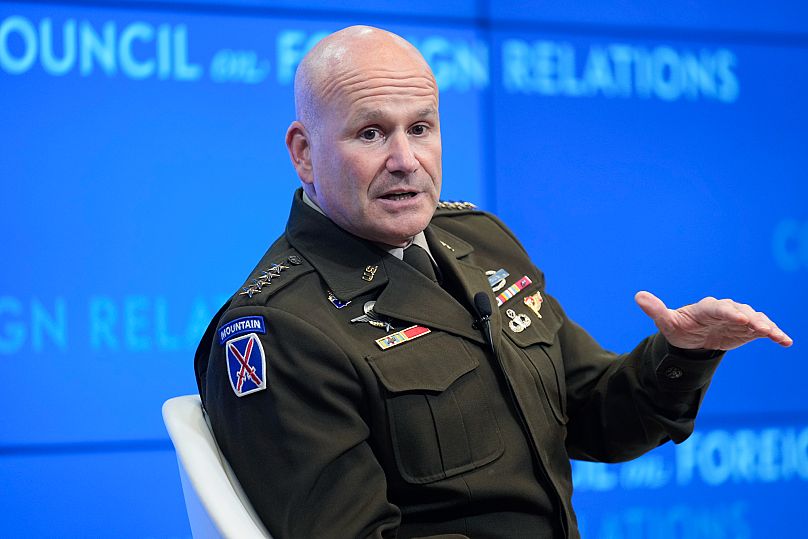
Heightening anxiety across Europe are unverified reports from U.S. media suggesting that the administration is considering stepping back from its key military role within the NATO alliance—the Supreme Allied Commander Europe (SACEUR). This post has traditionally been filled by an American military officer ever since NATO was established. While there’s no indication that General Christopher Cavoli, who currently leads the U.S. European Command, won’t be succeeded by another American, merely discussing this possibility would previously have seemed unimaginable.
The United States currently deploys approximately 100,000 military personnel primarily across Central Europe. Diplomats from European nations anticipate an announcement regarding the reduction of these forces; however, they express concerns about the specific terms under which such a drawdown might occur.
One diplomat noted that we should anticipate decisions being reached through a process involving consultations with our partners," they continued, "rather than as a result of any pact formed with Russia.
"As long as we do not see it reported in the media; that there is at least some form of procedure," the diplomat stated.
NATO Secretary General Mark Rutte tried to downplay the possibility of a reduction in American troops.
"They currently do not intend to abruptly reduce their presence here in Europe, but considering that America holds the position of a global superpower, it’s natural for them to focus on multiple regions rather than just one. It makes sense that this discussion has been ongoing,” he stated during last week’s Foreign Affairs summit. He further noted, “This conversation has persisted for several years now.”
During his first visit to Europe as US Defense Secretary, Pete Hegseth made a comparable statement when he visited Poland last February, noting that one cannot assume US troops will be indefinitely present.
However, a source close to Euronews indicated that it is entirely plausible there could be a relocation of U.S. troops away from the European mainland. Furthermore, appointing Elbridge Colby – known for his tough stance on China – as the Pentagon’s senior adviser on Tuesday is unlikely to calm these speculations.
Colby served as an adviser in the final Trump administration and has previously contended that the U.S. should withdraw forces from Europe and redeploy them elsewhere.
"I find it plausible that there might be unpredictable fluctuations in troop numbers," the source stated.
"A significant aspect of having SACEUR based in the U.S. was symbolic of American backing for Europe and their joint effort against the Soviet Union. Additionally, this role encompasses providing a nuclear deterrent, making these rumors particularly concerning," the source noted.
The current SACEUR’s support of these concerns won’t soothe tensions in Brussels. Last week, during testimony before the U.S. Senate, Cavoli stated that it would be "troublesome" if the United States were to step back from its leading position in commanding NATO forces in Europe.

0 Comments:
Post a Comment